
The in-silico stratification workspace for rare-cancer drug development

Ask the workspace:who responds?who's in the cohort?what does it know?where do models disagree?what did the lab do?

Drop in a target. Onkydra ranks candidate strata against a co-mutation cohort anchored to 60 real H3 K27M cases (DKFZ pediatric pan-cancer n=53, CPTAC pediatric brain n=7), flags where the ridge baseline and the mechanistic layer disagree, and is built to re-run when new evidence lands, once live monitoring is wired.

Overview

Rank the candidate strata, before you spend the money

A single glanceable page. Per-stratum ordering signal, where the baseline and the mechanistic layer disagree, the top resistance candidate, and the proxy status of every layer. Every number cites its source.

  • Per-stratum ordering signal with a descriptive 10th to 90th percentile band, and cohort frequencies bootstrapped over the 60 real cases
  • Agreement between the ridge baseline and the mechanistic layer, with the proxy status of each declared
  • Top resistance candidate from a literature-grounded ranking, with the LINCS reversal path declared as not yet live
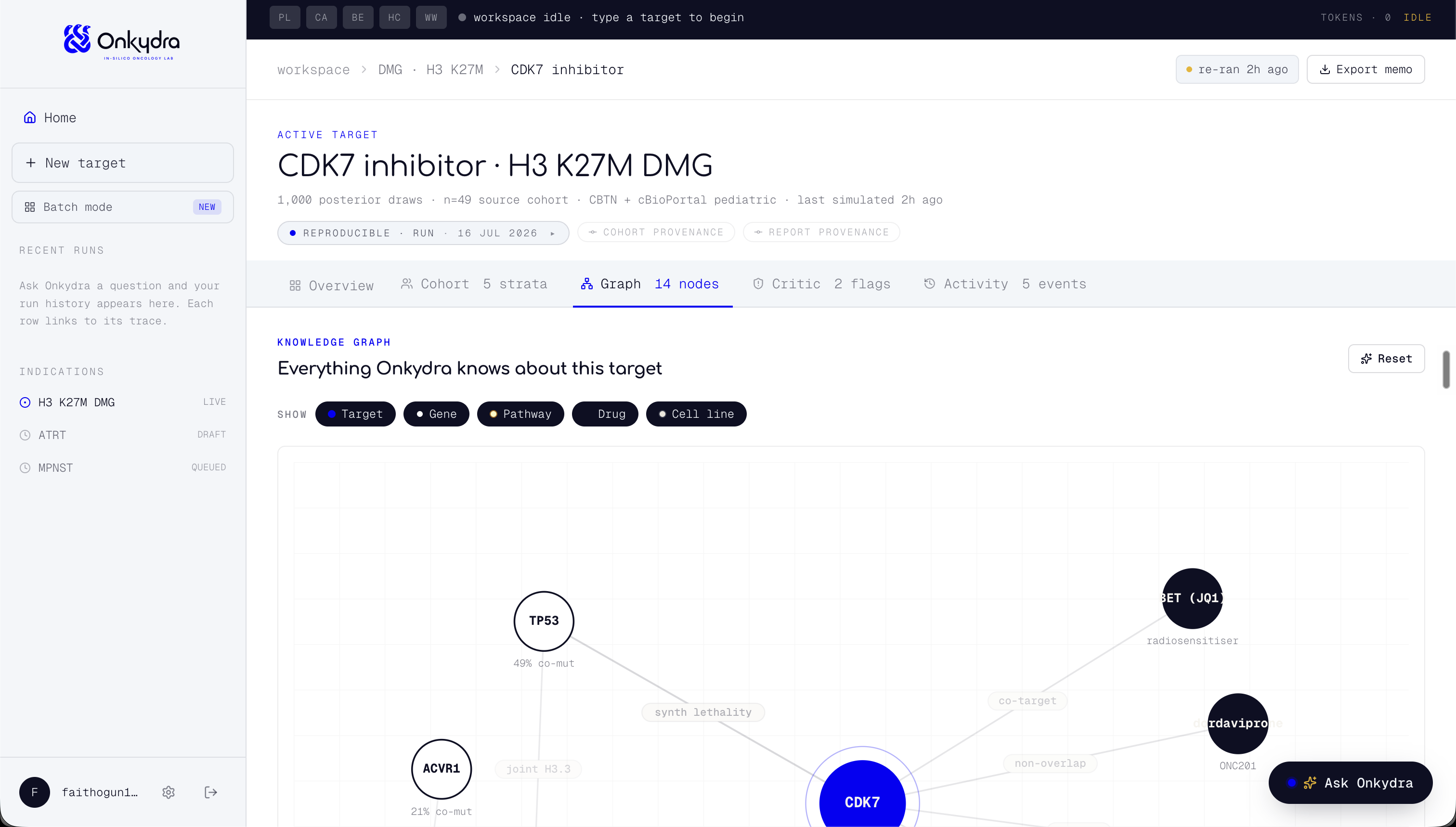
Onkydra workspace Overview tab

Private beta · Built on Gemini 3 and a Gaussian-copula cohort engine anchored to 60 real K27M cases

Why now

Rare-cancer drug development just changed shape

For forty years, diffuse midline glioma had no targeted therapy. In August 2025 it did. Three structural shifts converged within twelve months, and together they make a workspace like Onkydra possible for the first time.

01August 2025

DMG got its first targeted therapy

Dordaviprone (Modeyso) won FDA accelerated approval in August 2025 on a pooled n=50 across two trials. The first hit in a cancer that had nothing for forty years. A new generation of rare-cancer biotech founders is being funded around indications like this, and they need in-silico target validation that matches the size of the evidence.


022024 – 2026

Foundation models for biology shipped

scPRINT-2 trained on 350M cells under a permissive licence. AlphaGenome opened for non-coding variant calls. MedGemma landed on Vertex AI. The compute, the models and the data are now genuinely available to small teams. The bottleneck moved from infrastructure to methodology.

03June 2026

AI workbenches are the new baseline

Anthropic launched Claude Science on 2026-06-30. Multi-agent deliberation loops with adversarial critics, audit-logged tool calls, reproducible artefacts, structured citations at source. The interaction pattern is now the industry floor. Onkydra takes that quality bar and specialises it to the vertical where curated cohorts and honest CIs decide whether the report gets peer-reviewed.

PUBLIC DATA + AI STACK
cBioPortal

Rare-cancer cohorts (DKFZ + CPTAC)

Children's Brain Tumor Network
OpenPedCan (D3b Center, CHOP)

Paediatric cohort expansion · planned

DepMap (Cancer Dependency Map)
Broad Institute
Cellosaurus (SIB cell-line reference)

Cell-line dependency · proxy

LINCS L1000

Perturbation signatures · proxy

ClinVar

Variant significance · planned

Open Targets

Target-disease atlas

PubMed

Literature retrieval

TCGA / GDC

Adult tumour baseline

NCI Thesaurus (National Cancer Institute)
Human Phenotype Ontology

Cancer ontology + phenotype

OpenFDA Drug Labels

Regulatory anchoring

cBioPortal

Rare-cancer cohorts (DKFZ + CPTAC)

Children's Brain Tumor Network
OpenPedCan (D3b Center, CHOP)

Paediatric cohort expansion · planned

DepMap (Cancer Dependency Map)
Broad Institute
Cellosaurus (SIB cell-line reference)

Cell-line dependency · proxy

LINCS L1000

Perturbation signatures · proxy

ClinVar

Variant significance · planned

Open Targets

Target-disease atlas

PubMed

Literature retrieval

TCGA / GDC

Adult tumour baseline

NCI Thesaurus (National Cancer Institute)
Human Phenotype Ontology

Cancer ontology + phenotype

OpenFDA Drug Labels

Regulatory anchoring

cBioPortal

Rare-cancer cohorts (DKFZ + CPTAC)

Children's Brain Tumor Network
OpenPedCan (D3b Center, CHOP)

Paediatric cohort expansion · planned

DepMap (Cancer Dependency Map)
Broad Institute
Cellosaurus (SIB cell-line reference)

Cell-line dependency · proxy

LINCS L1000

Perturbation signatures · proxy

ClinVar

Variant significance · planned

Open Targets

Target-disease atlas

PubMed

Literature retrieval

TCGA / GDC

Adult tumour baseline

NCI Thesaurus (National Cancer Institute)
Human Phenotype Ontology

Cancer ontology + phenotype

OpenFDA Drug Labels

Regulatory anchoring

Gemini 3

Planner + Honesty Critic

Gemini 3

Genomics workhorse

Google DeepMind

Non-coding variants (AlphaGenome) · planned

Gemini 3
Google DeepMind

Imaging (MedGemma) · planned

scPRINT-2

Perturbation model · proxy

Broad Institute

Ensemble second model (Geneformer) · planned

Google Cloud

Vertex AI runtime

Gemini 3

Planner + Honesty Critic

Gemini 3

Genomics workhorse

Google DeepMind

Non-coding variants (AlphaGenome) · planned

Gemini 3
Google DeepMind

Imaging (MedGemma) · planned

scPRINT-2

Perturbation model · proxy

Broad Institute

Ensemble second model (Geneformer) · planned

Google Cloud

Vertex AI runtime

Gemini 3

Planner + Honesty Critic

Gemini 3

Genomics workhorse

Google DeepMind

Non-coding variants (AlphaGenome) · planned

Gemini 3
Google DeepMind

Imaging (MedGemma) · planned

scPRINT-2

Perturbation model · proxy

Broad Institute

Ensemble second model (Geneformer) · planned

Google Cloud

Vertex AI runtime

THE PROBLEM

The teams curing rare cancers can't afford to model them.

Tumour profiling at scale exists. It is just priced, built and validated for billion-dollar pharma, not for the small teams taking on the cancers pharma won't.

BENCHMARK · ILLUSTRATIVE

Anchor n vs foundation-model requirement

DMG anchor · DKFZ + CPTAC
Ewing anchor · DFCI + Curie
Onkydra draws per query
Foundation-model requirement
DMG anchor · DKFZ + CPTAC
60
Ewing anchor · DFCI + Curie
222
Onkydra draws per query
200
Foundation-model requirement
1000

The gap is the problem. Onkydra draws simulated profiles over the copula joint fitted to the real anchor. Bootstrap CIs stay on the real n.

How it works

Six surfaces. One world model. A lab that will watch your targets.

You give the workspace a target. The Planner picks the right simulation, the Biology Engine ranks the strata, the Honesty Critic checks the result for itself, and the Workspace Writer hands you the report with citations. The Delta Watcher is the sixth surface: it will watch ClinVar, DepMap and the literature and re-run when something moves the needle. That live monitoring is being wired, not running yet.

Picks the right tools01

Planner

Reads your question, picks the right cohort library, DepMap subset, and LINCS slice. Deterministic: no specialised syntax, no nine separate database interfaces.

Builds the world model02

Cohort Architect

Monte Carlo draws from a Gaussian copula joint fitted to your indication's real anchor cohort, with Ledoit-Wolf shrinkage on Σ. n=60 in DMG, pooled from DKFZ (n=53) and CPTAC (n=7), and including the H3.1 cases an earlier derivation missed. Tested against held-out cases never seen during fitting: single-gene frequencies reproduce at r=0.92 on 72 held-out DKFZ cases and r=0.59 against an independent institution. Every downstream statistic propagates that real n through bootstrap CIs you can see.

Runs the simulation03

Biology Engine

Ridge regression plus cohort statistics plus PubMed retrieval, returning a structured evidence bundle, never prose. CellOracle is real here: in-silico knockouts precomputed over a DMG regulatory network built from four real scATAC-seq samples and a 40,000-cell reference, served for the 47 transcription-factor regulators that produced signal, plus ACVR1 through an explicit ID1/ID3 bridge. For every other target it abstains rather than substituting a heuristic, the readout is an uncalibrated ordering signal rather than a probability, and it is not yet expert-reviewed. The scPRINT-2 layer runs as a labelled heuristic proxy with its serving endpoint written but not yet deployed, and the DepMap and LINCS layers run on curated placeholder rows pending live ingestion. Every report declares which is which.

Checks itself04

Honesty Critic

Flags where ridge and the foundation model disagree. Hard-fails on claims without retrieved source. Cross-checks the cohort's co-occurrence structure with a DISCOVER-inspired audit. The disagreement is the product.

Speaks in citations05

Workspace Writer

Consumes the evidence bundle. Cannot emit a sentence without a citation id. Renders the memo into your live workspace, and hands you the whole run (memo, agent trace, cohort manifest, citation ids) as a JSON download. A typeset PDF of the memo is in build, not yet live.

Re-runs on new evidence (in build)06

Delta Watcher

Live monitoring is being wired and is not live yet. It will watch ClinVar, DepMap and PubMed for changes on your targets, re-run the pipeline when something moves the needle, and flag shifts in the ranking. The drift calculation is written and tested; the scheduler that triggers it is not running.

INDICATIONS

Built for the cancers nobody else will model.

Onkydra launches with eight rare and paediatric cancers, starting with diffuse midline glioma, where real cohorts are smallest and synthetic ones matter most.

Beachhead · draft library

Diffuse midline glioma

The hardest cancer in paediatric neuro-oncology. The first targeted approval landed in 2025. New programmes need responder stratification today.

Driver

H3 K27M

Incidence

~300 / yr

Method-portable · roadmap

Ewing sarcoma

A fusion-driven bone and soft-tissue cancer of adolescents, with cohorts far too small for conventional modelling.

Driver

EWSR1::FLI1

Incidence

~200 / yr

Method-portable · roadmap

Malignant peripheral nerve sheath tumour

An aggressive nerve-sheath sarcoma, often arising in NF1, with few effective options across small, scattered cohorts.

Driver

NF1 loss

Incidence

~1,000 / yr

Method-portable · roadmap

Atypical teratoid / rhabdoid tumour

An aggressive infant brain tumour with one of the smallest cohorts in oncology: exactly where simulating the co-mutation structure matters most.

Driver

SMARCB1 loss

Incidence

~70 / yr

Method-portable · roadmap

High-risk neuroblastoma

The high-risk, MYCN-amplified subset where survival has barely moved in two decades.

Driver

MYCN amplified

Incidence

~600 / yr

Method-portable · roadmap

Anaplastic thyroid cancer

One of the most aggressive solid tumours known. Rare and fast-moving, where the speed of good trial design genuinely matters.

Driver

BRAF / TP53

Incidence

~700 / yr

Method-portable · roadmap

Rhabdomyosarcoma

The most common paediatric soft-tissue sarcoma. Still rare, and sharply split by fusion status.

Driver

PAX3::FOXO1

Incidence

~350 / yr

Method-portable · roadmap

Paediatric AML, KMT2A-rearranged

The KMT2A-rearranged subtype of paediatric AML, a high-risk group defined by its fusion and in need of better targets.

Driver

KMT2A fusions

Incidence

~120 / yr

PRICING

Priced for the job done, not the seat consumed.

Two ways to buy. A researcher gets a cited ranking of candidate strata by an uncalibrated ordering signal + ranked resistance candidates + a declared proxy status per evidence layer in 180 seconds per run. A team gets drift alerts and re-runs when ClinVar or DepMap moves (in build, not yet live). An engagement gets a memo reviewed by a domain expert before delivery. What you pay for is the artefact, not the session time.

Researcher
€99per month

For PhD students, postdocs, junior PIs. One workspace, up to three active targets in the launch indication. Memo export, fourteen-day free trial, and weekly auto-rerun (in build, not yet live).

Team
€499per month, per team

For a lab or a Seed-to-Series-A rare-cancer R&D team. Everything in Researcher, plus ten active targets. Multi-seat access for up to five people and shared programme memory are in build, not yet live: the workspace is single-user today, with no team or seat model behind it. Drift alerts when the evidence moves and scheduled reporting are also in build.

Researcher add-ons

Cohort packs: which indication should we build next?

Every Researcher seat ships with the DMG anchor cohort. Diffuse midline glioma is the only indication live today, and its library is draft, pending DMG-expert review. The rest are on the roadmap in the order below. Curating an indication means licensing and validating a whole molecular-profile library, so it is scoped as a custom indication engagement rather than a monthly add-on. Tell us which one you need and it moves up the queue.

Tell us which one →
  • Diffuse midline glioma

    Included

    H3 K27M anchor, n=60, DKFZ + CPTAC

    Included

  • Ewing sarcoma

    In the queue

    EWSR1 fusion, adolescent + young-adult anchor

    Roadmap

  • MPNST

    In the queue

    NF1-driven, malignant peripheral nerve sheath

    Roadmap

  • ATRT

    In the queue

    SMARCB1 loss, atypical teratoid rhabdoid

    Roadmap

  • High-risk neuroblastoma

    In the queue

    MYCN-amplified, paediatric

    Roadmap

  • Anaplastic thyroid

    In the queue

    BRAF V600E, TP53 co-mutation

    Roadmap

  • Rhabdomyosarcoma

    In the queue

    PAX-FOXO1 fusion, paediatric

    Roadmap

  • Pediatric AML (KMT2Ar)

    In the queue

    KMT2A-rearranged, infant + paediatric

    Roadmap

A pack leaves the queue once its anchor cohort has been curated and validated end-to-end through the run pipeline. Diffuse midline glioma is the only pack live today, and its library is draft, pending DMG-expert review. Every other indication listed here is roadmap, not shipped, and ships in order.

What a run delivers

Candidate strata ranked by an uncalibrated ordering signal, each with a descriptive 10th to 90th percentile band, the top-3 ranked resistance candidates, a declared proxy status for every evidence layer, and a citation-backed narrative. Every claim linked to a real source, every cohort frequency resampled over the real anchor n.

What a workspace delivers

A live lab that will watch ClinVar, DepMap, and the literature between visits and re-run when something shifts the lead stratum's ordering signal by more than five points or drops critic agreement below 0.7. The drift calculation is written and tested. Live monitoring is being wired, so it is not running yet.

What a founder engagement delivers

A board-ready memo reviewed by a domain expert before delivery, custom indication parameterisation curated for your specific cancer, explicit acceptance criteria agreed up front, and a follow-up analysis. The engagement, not the seat.

Patient-advocacy foundations can sponsor Researcher seats in bulk from €59 per seat / month. See the sponsorship tiers.

THE TWO ENGINES

A five-stage pipeline that checks itself, fed by a composite of the real evidence we do have.

Onkydra is two engines working in concert. Hydra runs the five stages that assemble the report. Chimera samples the co-mutation profiles those stages run on. Both are built for cancers where the incumbent stack has too few patients to work with.

Hydra

Five-stage pipeline with a self-check

Five stages run in sequence: Planner, Cohort Architect, Biology Engine, Honesty Critic, Workspace Writer. The Honesty Critic flags where the ridge baseline and the mechanistic layer disagree, and declares which layers ran as proxies. It refuses to let a claim ship without a real source. Cut one head off, two grow back.

See the pipeline

Chimera

Simulated co-mutation profiles

Every draw is a simulated co-mutation profile, sampled from a Gaussian copula fitted to n=60 real H3 K27M DMG cases from DKFZ and CPTAC, Ledoit-Wolf shrinkage on Σ. One thousand Monte Carlo draws. Every CI resampled over the real 60, not the simulated 1,000. Same posture as the FDA's 2025 dordaviprone approval on n=50 with 22% ORR: the size of the underlying evidence is the size of the field.

Read the methodology

Founder-product fit

Onkydra is built by Faith Ogundimu, a cancer-genomics researcher, for the teams developing the drugs pharma won't. The workspace answers the questions Faith asks in her own PhD work: which subgroup responds, what breaks first under selection, what does the literature already know that we missed.

Research use onlySee scope

PRIVATE BETA

Get early access to Onkydra.

We are onboarding a small group of biotech and research teams working on rare cancers. Join the waitlist and we will reach out with a first run for your programme.

No spam. We email you once, when your run is ready.

Onkydra is in private betaJoin